To listen to this episode visit the Federal News Network.

By Tracy Mason
The ASPIRE ONE Lunar Record lands on the Moon’s Mare Crisium to establish a new theoretical framework for planetary-scale archival communication.
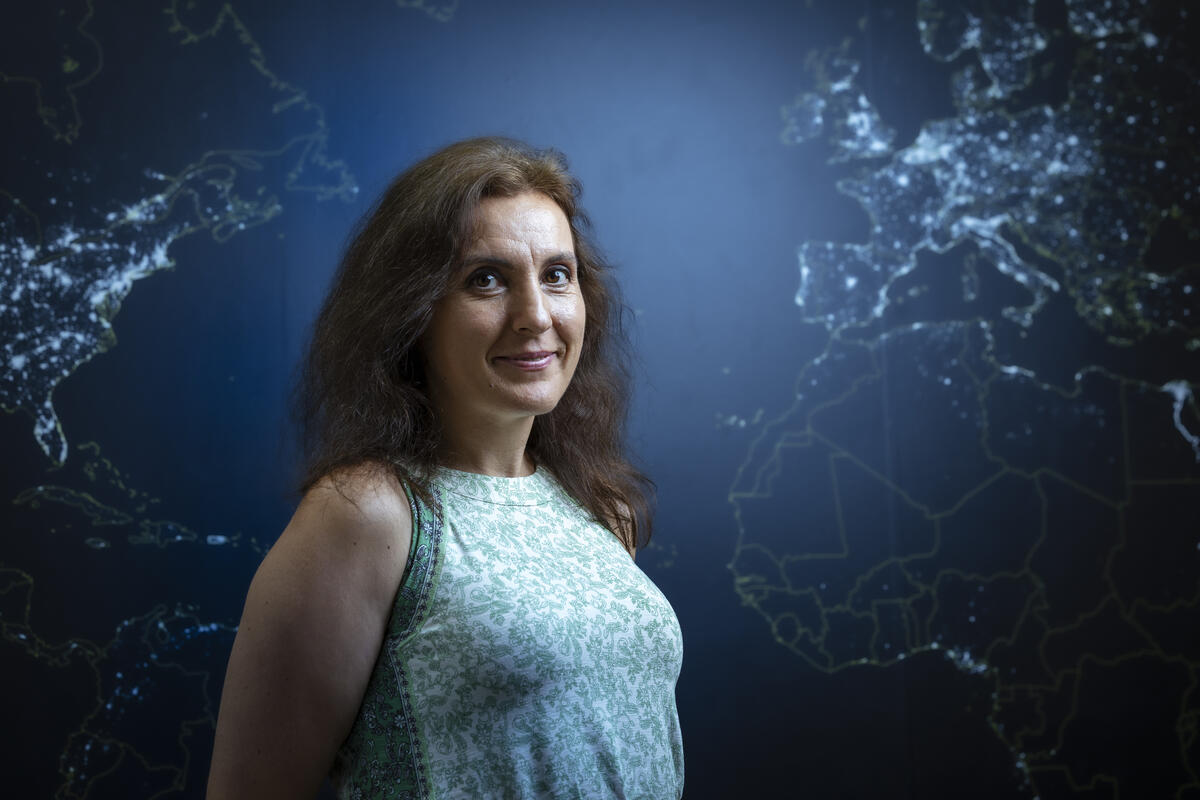
On January 15, 2025, the ASPIRE ONE Lunar Record launched into orbit as part of the LifeShip payload on the Ghost Riders in the Sky Lunar mission from the Kennedy Space Center in Florida. And early Sunday, March 2, 2025, we collectively celebrated the payload’s successful moon landing, a groundbreaking moment in space exploration. This mission, a part of NASA’s CLPS initiative within the Artemis program, includes the ASPIRE ONE Lunar Record, the result of the work of an interdisciplinary research team, led by Anamaria Berea, an Associate Professor of Computational and Data Sciences at George Mason University.
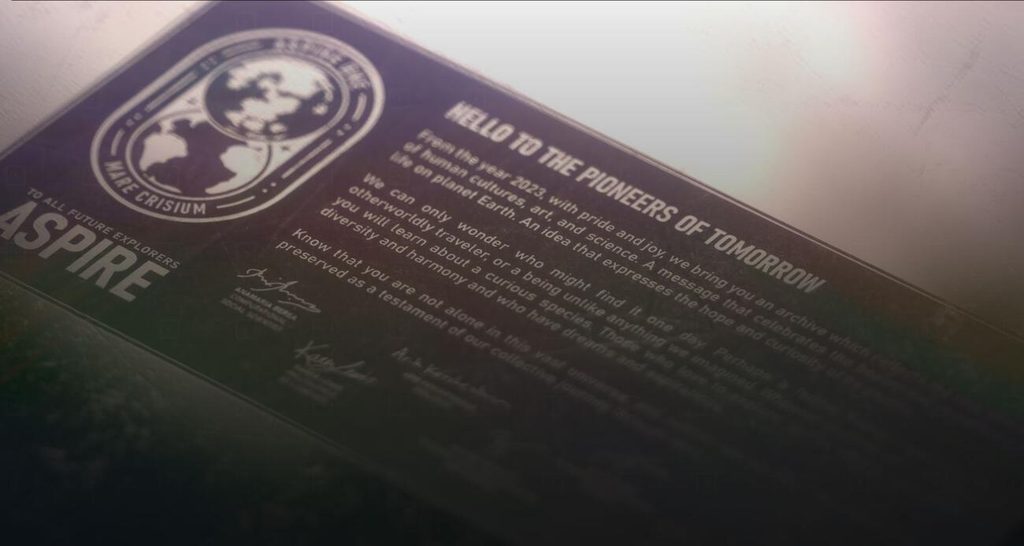
This ambitious project intends to preserve Earth’s cultural and scientific heritage for posterity by placing a specially designed payload on the Moon. The digital portion of this payload, which mirrors the concept of the Voyager Golden Records, will serve as a time capsule for future humans, offering them a glimpse of life on Earth during the early 2020s.
The creation of this extraordinary lunar archive was a collaborative effort that began in early 2023, when Nick Searra, founder of the Interstellar Foundation, invited Berea to lead the project. Despite having no initial team or funding, Berea quickly gathered a group of scientists, philosophers, and linguists from prestigious institutions such as Barnard College, Columbia University, and the University of Cambridge. The team also received support from notable figures, including astronaut Scott Kelly and Dr. Jonathan Jiang from NASA’s Jet Propulsion Laboratory.
With a tight deadline of just six months, the team worked tirelessly to create a message that could fit within the strict digital space limitations of the payload. The biggest challenge was deciding what to include. The team wanted the message to be a ‘dry-run’ for future, more extensive interstellar messages, ultimately settling on content that would be meaningful to archeologists or future pioneers.
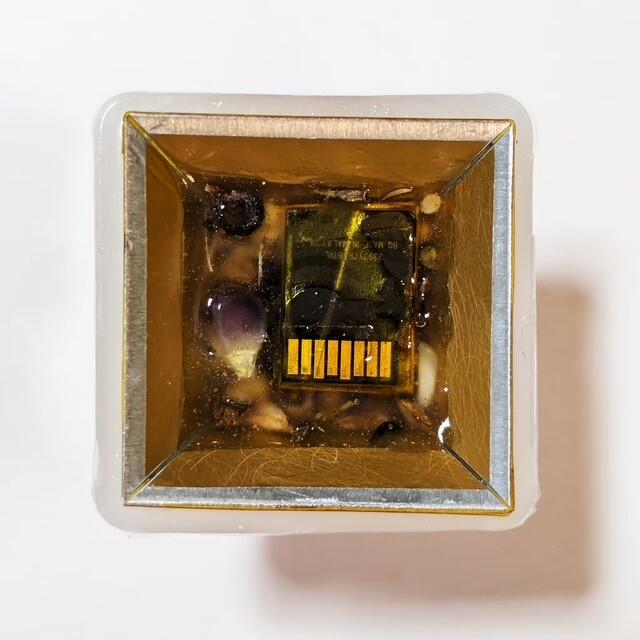
The ‘Pyramid on the Moon’ payload, delivered on special physical mediums designed for space provided by mission partner LifeShip, contains a wealth of diverse content, including videos, scientific materials, global aspirations, historical records, and cultural artifacts. “With its successful landing, the payload will reside on the Moon for posterity and eternity,” Berea said.
“With no weathering on the Moon, it could last a billion years and be the longest living human archive,” said Ben Heldeman LifeShip founder and CEO. “Although small in size, the Pyramid crafted from anodized aluminum in a golden hue, fits in the palm of one’s hand and is densely packed with information,” explained Heldeman.
The ASPIRE ONE Lunar Record includes a 1GB microchip containing videos, images, and texts that highlight humanity’s journey on Earth and the Moon, incorporating materials that reflect Earth’s cultural, scientific, and historical achievements. Among the key items is a 24-minute ‘Daily Life’ video that showcases global snapshots of contemporary life. Each minute represents one hour from various parts of the Earth, from morning to night, and includes scenes of families cooking, children in school, workers in offices and fields, and people participating in cultural events. This visual ‘quilt,’ stitches together snapshots from diverse cultures, including indigenous communities, showcasing daily routines from all corners of the planet.
The payload also includes an ‘Aspirations’ video, where individuals from around the world share their hopes for the future in their native languages. In addition, the payload houses images and content from UNESCO and Getty archives, including a representation of the COVID-19 pandemic. Other materials include the constitutions of 192 countries on Earth, the Apollo 11 launch codes, historical works, art, music, and scientific texts, such as works by Newton, Curie, and Asimov. Berea even includes a personal touch with an engraving of her name and affiliation with George Mason University, symbolizing her contribution to this historic effort.
“The goal of the project was not to tell the story of famous individuals or events but to encapsulate a broader representation of human life,” Berea explains. The video content, compressed to fit within the payload’s storage constraints, offers a tapestry of daily human experiences. According to Berea, the project team chose a video format, blending video, subtitles, and code, as they believed it would be more easily understood by future beings, whether human or otherwise.
In addition to the digital content, the team took precautions to ensure the message could survive for millennia. In case digital technology becomes obsolete, parts of the message were engraved in analog nano-fiche and synthetic DNA on a 1MB capsule. This forward-thinking approach ensures that future civilizations, regardless of technological advancement, could access the message.
One of the most significant aspects of the ASPIRE ONE Lunar Record is the ethical responsibility of leaving a message for future generations. The team grappled with questions such as who the “receiver” of the message would be and what content would best represent humanity. “Who speaks for Earth?” they asked, recognizing the great responsibility of crafting a message that would stand the test of time.
“I have been honored and fascinated to collaborate with this interdisciplinary team of the most amazing scientists, humanists, artists and people from all walks of life,” said Berea. “I am forever grateful to my team and our collaborators for their trust, their dedication, their passion and their support to this project that will give us a tiny place in our interstellar future history.”
The payload is very small, the size of a coin, and encapsulated within a LifeShip Pyramid. It is integrated right above one of the legs, and below the other instruments. It will remain on the lander and in this position forever. The LifeShip Pyramid, crafted from anodized aluminum in a golden hue, includes the following:
– A Seed Bank: Includes seeds from 100 of humanity’s most essential plant species.
– The Complete Human Genome: The human DNA digital code etched into Cerabyte ceramic to last a billion years.
– AI messenger: The code for Gaia AI, a Large Language Model trained as a communicator from Earth to potential future explorers.
– Sacred Waters: Collected from 33 sites worldwide to honor Earth’s life-sustaining waters.
– A Cultural Archive: A snapshot of human thought, creativity, and stories, curated with partners including Lunar Codex, LunARC, MoonMars, The Museum of Ideas, United Planet, Copernic, and the Interstellar Foundation printed on ultra-durable NanoFiche memory plates.
– Wikipedia Encoded in DNA: In collaboration with the Arch Mission Foundation and Catalog, preserving a vast record of human knowledge.
Pyramid images provided by LifeShip.