George Mason Space Collaborative

IN THE MEDIA: Could faster-than-light particles send messages into the past?

Scientists have long used the hypothetical concept of faster-than-light particles to explore the limits of physics, causality, and time. 

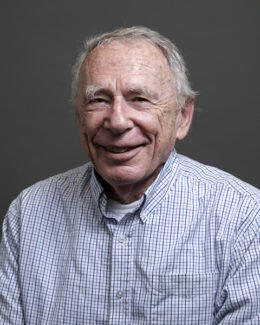
Robert Ehrlich, professor emeritus in the George Mason University Department of Physics and Astronomy, spoke with Popular Mechanics about tachyons, hypothetical particles that would always travel faster than light. If such particles existed, they could theoretically make it possible to send messages into the past, although they have never been observed.  

Ehrlich explained that Einstein’s theory of special relativity prevents particles traveling below the speed of light from being accelerated beyond it because doing so would require infinite energy. However, Einstein did not explicitly rule out particles that had always traveled faster than light. 

The article also discusses Ehrlich’s research into whether neutrinos detected around the 1987 supernova SN 1987A could provide evidence about neutrino mass and the possibility of faster-than-light behavior. His paper is currently available as a preprint and is being submitted for peer review. Ehrlich also noted that most physicists do not believe the available observations show that neutrinos travel faster than light. 

Read the full article in Popular Mechanics.

George Mason partners with Oxford-based TreQ to bring the first open-architecture quantum computing system to Virginia

Located on one of George Mason’s Northern Virginia campuses, the system will be the first U.S. deployment of a computing system based on TreQ’s proprietary Open Architecture Quantum (OAQ) framework. With strategic support from Virginia Innovation Partnership Corporation (VIPC) and TreQ, George Mason is investing in the new $7.7 million system planned for delivery and installation in early 2027, with commissioning expected by late summer 2027. The university commercialization and researcher recruitment grant from VIPC is helping to catalyze and attract strategic industry investment and additional philanthropy support for Virginia’s ecosystem. 

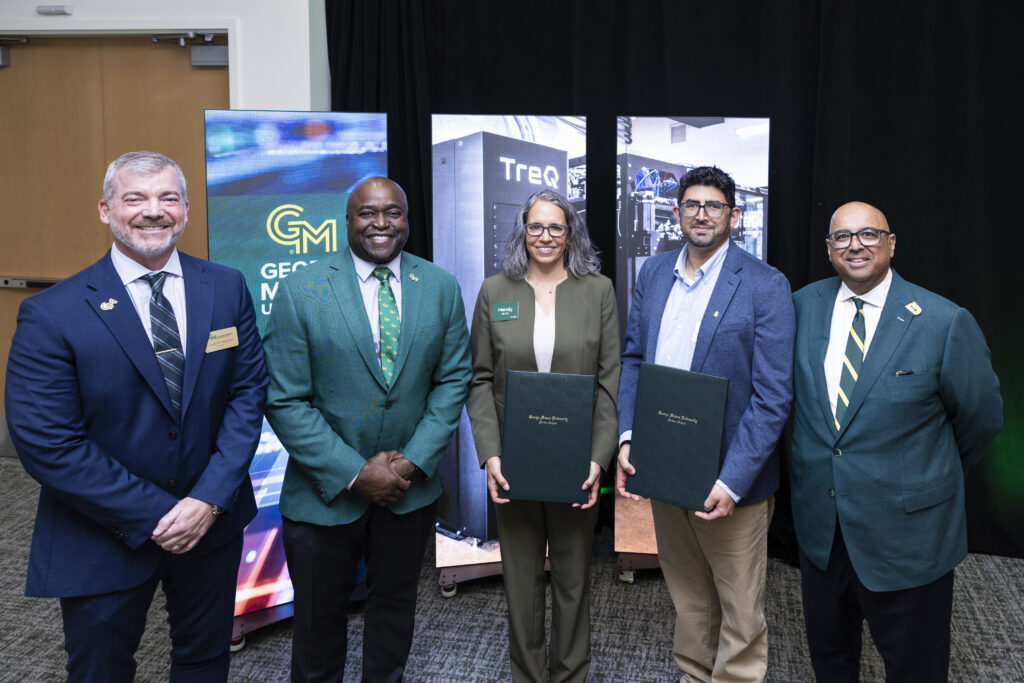
George Mason President Gregory Washington and TreQ CEO and Founder Mandy Birch sign an MOU to bring TreQ’s open-architecture quantum infrastructure to George Mason University. The system will be the first U.S. deployment of a computing system based on TreQ’s proprietary Open Architecture Quantum (OAQ) framework. Photo by: Ron Aira/Creative Services/George Mason University

“Open architecture widens the path for innovation, allowing for different quantum processors, software, networking, and other technologies as they mature, rather than a single integration approach,” said TreQ CEO and Founder Mandy Birch. “That gives established companies, startups, and researchers a place to build, test, and integrate, and move the field forward faster. This first deployment creates a foundation Virginia can keep building on, and we’re glad to be part of George Mason’s vision for what comes next.” 

TreQ will design, deploy, and operate the new built-to-evolve quantum computing infrastructure at George Mason, collaborate on research and curriculum, and connect Virginia and the region with companies and innovators across the global quantum technology ecosystem. 

“VIPC’s mission is to grow Virginia’s innovation ecosystems through public–private partnership. This unique collaboration with George Mason, TreQ, and other partners will help attract industry investment, accelerate research commercialization, develop next-generation talent, and empower entrepreneurs and startups to advance cutting-edge quantum technology in the commonwealth,” said VIPC President and CEO Joe Benevento. “VIPC is proud to provide catalytic funding to help unlock these exciting opportunities for Virginia’s future.”

Quantum computing is expected to reshape fields including public health and medicine, emergency response, logistics, national security, and infrastructure. Quantum computing is predicted to generate up to $2.7 trillion in economic value internationally by 2035, limited only by two barriers: a shortage of trained talent and the high cost of specialized infrastructure. Alongside ambitious research and interdisciplinary quantum curriculum, the investments at George Mason will help expand access and accelerate discovery, building toward a quantum-enabled future that overcomes both those obstacles.

“The open architecture system provides needed infrastructure to work across the full quantum stack, and fuels rapid innovation that no single organization could tackle alone, advancing the region as a magnet for the quantum supply chain,” said College of Science Dean Cody Edwards. “Open architecture isn’t about being vendor-neutral. It changes what’s possible by opening the system to more technologies and innovators. With the infrastructure and curriculum to train the workforce, George Mason can help drive the advanced computing economy forward.” 

This partnership builds on George Mason’s Quantum Science and Engineering Center (QSEC), where 24 faculty across seven departments and several colleges have developed the university’s foundation in quantum. QSEC also recently signed an MOU with two of Korea’s leading quantum organizations, the Future Quantum Convergence Forum and the QCI Quantum-AI Convergence Center (QCI), establishing an international relationship with a key U.S. ally in technology and workforce.

Quantum is a priority area within George Mason’s Grand Challenge Initiative — a university-wide effort to focus talent and resources on problems of regional and national consequence — and the university is backing it with a $2.4 million catalyst investment, six new postdoctoral positions, and three new faculty positions. The university also launched Virginia’s first interdisciplinary master’s degree in quantum science and engineering. With 80-85% of George Mason graduates working in the Commonwealth of Virginia and the region, the university is creating a talent pipeline to meet the region’s workforce needs.

“George Mason engineering is advancing the frontiers of quantum computing through pioneering research, transformative student experiences, and strategic partnerships with innovators such as TreQ,” added College of Engineering and Computing Dean Ken Ball. “We are preparing the next generation of engineers to turn quantum breakthroughs into practical solutions that will shape the future of technology and society.”

As a top-rankeduniversity, George Mason is already working with regional and industry partners across the state to formalize a broader quantum coalition that is shaping quantum research and workforce development. The new system will also serve as foundational infrastructure for international companies exploring expansion into Northern Virginia. 

“Our partnership with TreQ gives QSEC faculty and students access to true quantum computing hardware for the first time,” said QSEC Director Patrick Vora. “We can now launch ambitious new research initiatives, build globally unique workforce training programs, and team with our industry colleagues to grow the Virginia quantum ecosystem. This will truly let Virginia take a quantum leap and drive the future.”

IN THE MEDIA: George Mason astronomer explains the Perseid meteor shower

The annual Perseid meteor shower is giving stargazers across Northern Virginia a chance to catch one of the year’s most anticipated celestial displays.

In a recent Prince William Times article, Peter Plavchan, professor of physics and astronomy at George Mason University and outgoing executive director of the Mason Space Exploration Center, explains what causes the meteor shower and how viewers can get the best look.

The Perseids occur as Earth passes through a trail of dust and rock left behind by the Swift-Tuttle comet. As those particles enter Earth’s atmosphere, they vaporize, creating the streaks of light commonly known as shooting stars.

Under ideal conditions, viewers could see as many as 100 meteors per hour. Plavchan recommends finding a dark location away from light pollution and allowing time for your eyes to adjust to the night sky.

He also notes that meteors can appear in different colors depending on the elements contained in the debris as it vaporizes.

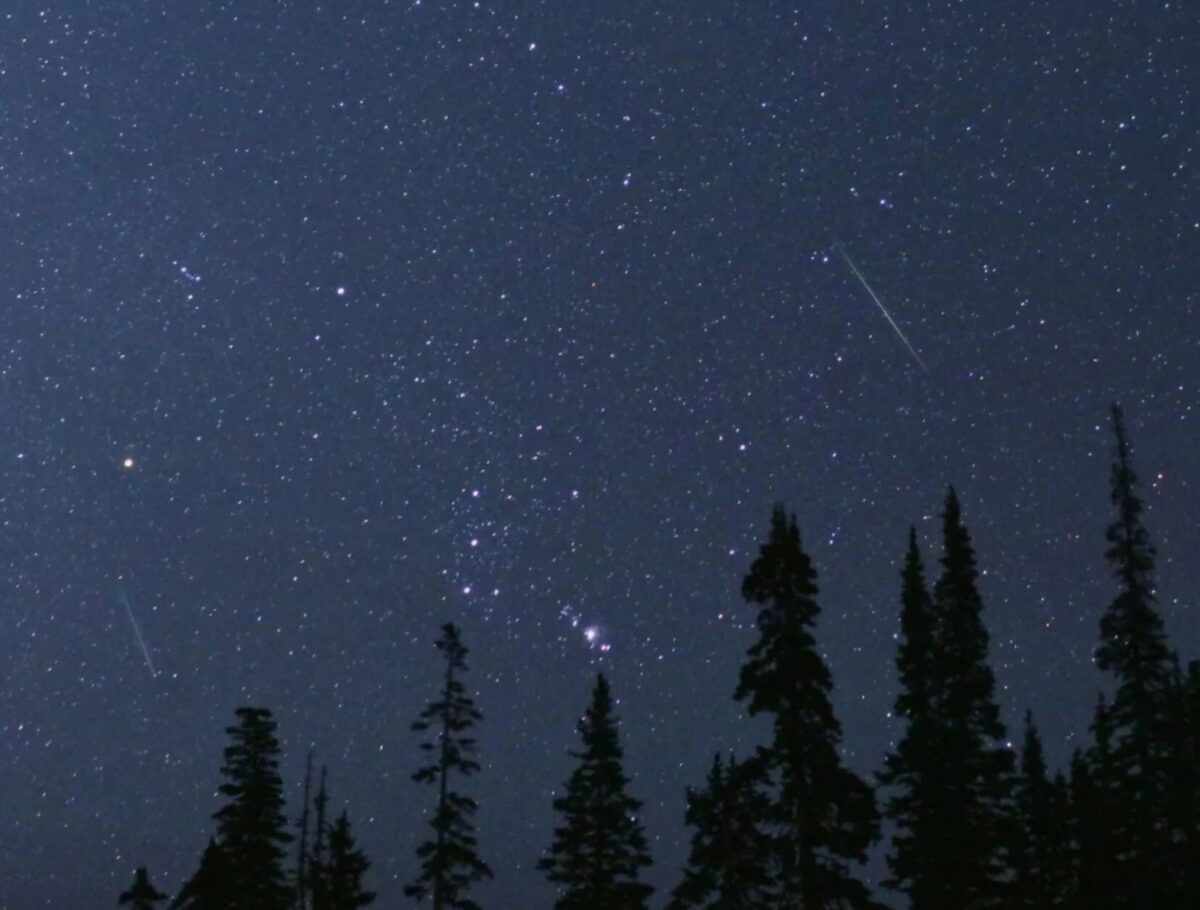
Photo: Perseid meteors in Utah in 2018. 

Read more in the Prince William Times.

Science focus on Five of Seven Grand Challenge Initiative First Round Projects Selected

As the university’s Grand Challenge Initiative (GCI) enters its second year, George Mason University recently announced funding for seven catalyst research projects and the launch of the Grand Challenge Research Exchange—quarterly convenings for all GCI-related research to accelerate solutions to the grand challenge of our time. Our College of Science is a strong participant in the initiative, leading and collaborating in five of the seven new catalyst projects involving over two dozen of our scientists.

“We have placed our first bets on building a better future for humanity,” said President Gregory Washington. “These awards represent the very best of George Mason faculty research. They sit at a crossroads where the world’s greatest problems meet our faculty’s greatest research strengths to solve them. At a time when the world’s greatest challenges can appear to be winning, today the smart money is on George Mason professors.”

“This round of Grand Challenge Initiative funding reflects what the College of Science does best—bringing together bold ideas, deep expertise, and collaborators across disciplines to tackle problems that truly matter,” said Dean Cody W. Edwards. “From quantum science and space systems, to climate risk and humanitarian forensics, our scientists are not just advancing knowledge—they are building solutions with real-world impact. We’re proud to help lead an effort that positions George Mason at the forefront of shaping a more resilient, just, and prosperous future.”

College of Science projects, in collaboration with the Carter School for Peace and Conflict Resolution, College of Engineering and Computing, College of Humanities and Social Sciences, College of Education and Human Development, College of Public Health, Costello College of Business, Scalia Law School, and Schar School of Policy and Government, and participating faculty include: 

  • George Mason’s Quantum Leap will expand George Mason’s strength in quantum hardware, algorithms, degree and training programs, and workforce development for Virginia’s emerging quantum economy. Principal Investigator: Patrick Vora 
  • George Mason University Space Collaborative will design and launch small satellites that generate data for climate forecasting, disaster preparation, infrastructure protection, and scientific discovery, and expand degree and training programs. Principal Investigators: Anamaria Berea and Ferah Munshi
  • Toward a Center for Aerial Intelligence and Digital Earth Histories will digitize and analyze unclassified historical aerial archives into usable digital data resources for research, education, and societal impact—laying the groundwork for a future full‑scale center. Principal Investigator: Dieter Pfoser
  • Industry–University Working Group on Climate Change and Physical Risks will advance understanding of shifting climate hazards and develops practical tools that strengthen physical risk assessment and decision-making for the insurance, reinsurance, and finance sectors of the economy. Principal Investigator: Luis E. Ortiz 
  • Humanitarian Forensics and Peacebuilding will improve how human remains are located, identified, and reunified with families after conflict or disaster. Principal Investigator: Joseph DiZinno 

The new seven catalyst projects were selected from 41 proposals, with more than 75 PIs, submitted across every college and school at George Mason, including Mason Korea. More than 35 external partner organizations were represented across submissions; 38 were transdisciplinary, and six involved five or more colleges working together. 

 “What makes the Grand Challenge Initiative so powerful is its focus on collaboration—across colleges, sectors, and communities—and the College of Science is proud to be a central partner in that work,” said Edwards. “These projects not only address urgent global challenges, they also create unmatched opportunities for our students to learn, contribute, and lead at the intersection of science, policy, technology, and society.”

“George Mason’s institutional investment underscores our commitment to high-impact, interdisciplinary mission-driven research,” said Andre Marshall, vice president for research, innovation, and economic impact. “GCI positions research to build our enterprise and engage additional funders to deliver real-world change.”  

To support all GCI-related research, including the 41-proposal cohort, through stages of development, George Mason is launching new quarterly convenings called the Grand Challenge Research Exchange. The first convening will launch this fall. Designed in partnership with the three Office of Research, Innovation, and Economic Impact (ORIEI) Institutes and Mason Now team, these exchanges will feature industry keynotes, expert guest lecturers, and professional development workshops about leadership development, strategic planning, financial and program management, funding support, proposal and partnership development, and community engagements models.   

“The College’s significant financial investment recognizes the strategic value of these efforts, contributing $1.29 million to support faculty hires and project success,” Edwards said. “In addition, the ongoing training will be an excellent opportunity for all 18 of our GCI first round submissions to continue our high level of engagement in the Grand Challenge Research Exchange to continue to reap the strategic and professional development benefits going forward.”

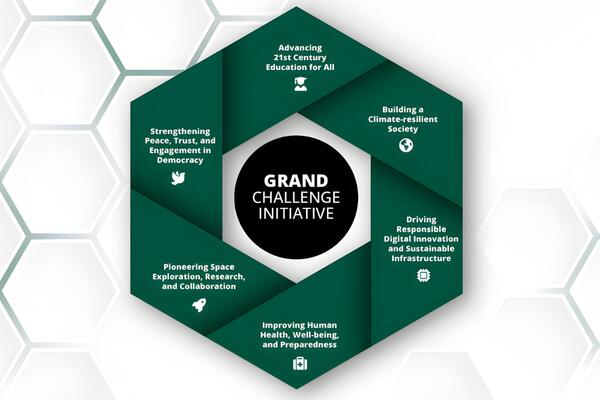
George Mason’s Grand Challenge Initiative is a five-year campus wide initiative with an initial $15 million investment to mobilize interdisciplinary expertise and drive bold solutions for a changing world. The six solutions are advancing 21st-century education; building a climate-resilient society; driving responsible digital innovation and sustainable infrastructure; improving human health, well-being, and preparedness; pioneering space exploration; and strengthening peace, trust, and engagement in democracy. GCI will fund more than 20 solutions-based catalyst research projects over the next four years.

Read the Full Article ….

George Mason University Scientist Part of NASA EDGE Mission to Track Earth’s Changing Ice and Forests

By Laura Powers

A George Mason University scientist is helping NASA measure changing ice and forests with a newly selected satellite mission. Konrad Wessels, associate professor of geography and geoinformation science, is part of a NASA-funded science team that developed a new mission concept for studying how ice levels and ecosystem carbon stock are changing—work that could impact climate resilience planning, disaster management, ocean navigation, and national security.

Wessels is contributing to NASA’s Earth Dynamics Geodetic Explorer mission (EDGE), which will be the world’s first satellite system to use imaging laser altimetry to map Earth’s surface. Selected after a two-year development and evaluation process, this EDGE mission relies on laser altimetry, a technique that sends pulses of light toward Earth and measures the time it takes for them to reflect back to the spacecraft. These measurements allow scientists to precisely calculate the elevation of land, ice, and 3D forest structure. If confirmed, the total estimated cost of EDGE, not including launch, will not exceed $355 million, with a mission launch date of no earlier than 2030. 

“The NASA EDGE mission will generate high-resolution, three-dimensional views of forests and savanna ecosystems, along with detailed measurements of glaciers, ice sheets, and sea ice,” explained Wessels. “Together, these data will help scientists better understand how ice and forests are changing over time but also has a rapid response capability to collect higher-detail data in case of emergencies or natural disasters.”

Wessels’ role has focused on ensuring the mission can accurately track changes in the world’s forests and savannas. As a member of the Terrestrial Ecosystems Science team, he helped develop a Science Traceability Matrix, a framework that connects the mission’s scientific objectives to specific measurement requirements, such as forest height, fire fuel loads, biomass/carbon stocks, and their changes. This process directly informs the design of the mission’s LiDAR sensor, satellite orbits, and data-processing methods. 

“Tracking global forest carbon stocks is critical for understanding how Earth is responding to environmental change, especially since carbon emissions from land-use change and forest degradation rival those from the entire transportation sector,” Wessels said. “By improving our ability to monitor forests worldwide, this mission can inform natural resource management efforts that aim to protect forest carbon stocks and biodiversity along with many ecosystem services. EDGE could provide a quantum leap forward in monitoring forest structure and dynamics around the world.”

The EDGE mission brings together 25 scientists and engineers from institutions around the world, including principal investigator Helen Amanda Fricker of the Scripps Institution of Oceanography, University of California San Diego, with John Armston of the University of Maryland serving as deputy principal investigator. Mission leadership also includes Instrument Principal Investigator Bryan Blair and Project Scientist Scott Luthcke from NASA’s Goddard Space Flight Center in Greenbelt, Maryland.

In a NASA-issued press release, Nicky Fox, associate administrator of the Science Mission Directorate at NASA Headquarters in Washington, D.C., described the importance of EDGE and the recently advancing STRIVE missions, “By understanding Earth’s surface topography, ecosystems, and atmosphere, … these missions will help us better study the extreme environments beyond our home planet to ensure the safety of astronauts and spacecraft as we return to the Moon with the Artemis campaign and journey onward to Mars and beyond.”

Deputy PI John Armston University of Maryland spoke to Wessels’ contributions saying, “Konrad has helped shape EDGE’s science to capture the dynamics of savanna ecosystems and their response to disturbance and environmental change and will play a key role in the mission’s calibration and validation efforts across terrestrial ecosystems.”

In addition to Wessels from George Mason, the terrestrial ecosystem structure team includes researchers from Boise State, the National University of Singapore, the Smithsonian Tropical Research Institute, UCLA, the University of Bristol, the University of Maryland, U.S. Forest Service, and the U.S. Geological Survey. The ice elevation team includes scientists from the British Antarctic Survey, the Colorado School of Mines, the University at Buffalo, the University of Tasmania, and the University of Washington.

The EDGE project has been selected for continued development as part of NASA’s Earth System Explorers Program, which conducts principal investigator-led Earth science missions based on key priorities laid out by the science community and national needs. The EDGE mission will be subject to confirmation review in 2027, which will assess the mission’s progress and the availability of funds.

George Mason University named lead academic partner for Connected DMV’s spaceNEXT

Connected DMV has announced that George Mason University, one of the nation’s most innovative and fastest-growing public research universities, will serve as the Lead Academic Partner for spaceNEXT, the inaugural global convening focused on the commercialization of space and a flagship program of Connected DMV’s Potomac Center for the New Space Economy.  

The spaceNEXT event will take place February 18–20 at Capital One Hall in Tysons, Virginia, and bring together global leaders across industry, government, academia, and the investment community to accelerate what’s next in the space-for-space and space-for-Earth economy. 

“George Mason is the ideal academic anchor for spaceNEXT. Their leadership in space science, satellite engineering, and frontier research perfectly aligns with our mission to build Greater Washington into the global capital of the new space economy,” said George Thomas, president and CEO, Connected DMV. “This partnership brings world-class expertise, talent, and innovation to the main stage, and we couldn’t be prouder to shape this inaugural event together.” 

George Mason’s collaborative and creative research strengths align directly with the new space economy 

Advancing space innovation that serves life on Earth—through Earth observation, remote sensing, planetary exploration, and space weather research—is a core focus of George Mason’s Grand Challenge Initiative, which aligns research, education, and partnerships around solving problems that shape the future of humanity. The university’s growing strengths in robotics and autonomy, artificial intelligence, quantum science, integrated sensing and communication, and sustainable cyberinfrastructure—anchored by Fuse at Mason Square—support next-generation capabilities such as autonomous spacecraft operations, in-space servicing, on-orbit manufacturing, and resilient space infrastructure that connect scientific discovery to real-world impact. 

“Our future in space is a key component to solving humanity’s grand challenge of creating a peaceful, healthy, and prosperous future,” said Andre Marshall, vice president for research, innovation, and economic impact. “George Mason is forging strategic partnerships and driving novel research across disciplinary boundaries to help shape and secure this bold future, recognizing that it will reach far beyond the Earth’s atmosphere, and we are proud to partner with Connected DMV to further these ambitious goals.”

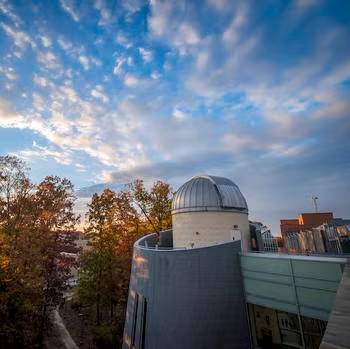
The George Mason College of Science’s multi-million-dollar portfolio in Earth- and space-observation research gives the university the region’s strongest capabilities in satellite data, remote sensing, and climate-driven analytics. Home to the Center for Earth Observing and Spatial Research, the  Satellite and Earth System Studies Program, the Center for Geospatial Intelligence, and the second largest observatory on the East Coast, the College of Science maintains research collaborations with NASA, NRL, Department of Energy, Defense Threat Reduction Agency, Air Force Office of Scientific Research, and the Army Research Office, as well as a  recent $13M collaboration with the Department of the Navy to study increased solar activity. These fields underpin the expanding market for commercial Earth intelligence, environmental monitoring, and mission-critical geospatial tools, while offering immersive training for tomorrow’s scientists and regional workforce.   

“The future of space commercialization will be driven by institutions like George Mason that can bridge scientific discovery, facilitate industry collaboration, and drive real-world innovation,” said College of Science dean Cody W. Edwards. “For years, we have invested in the research, facilities, and workforce development infrastructure to become a valued partner in the emerging space economy. We look forward to bringing George Mason’s research, talent, and entrepreneurial spirit to this global convening—and to helping chart the course for the next era of space exploration and economic growth in the region and beyond.” 

George Mason’s College of Engineering and Computing is also a regional leader in workforce development for the new space economy. Its graduate Small Satellite Engineering program trains engineers in full spacecraft lifecycles—including design, power, communications, sensors, attitude control, and resilient architectures—while the university’s CubeSat Engineering Lab and satellite ground stations (including a 9.1-meter dish) provide students and researchers hands-on experience with small satellite buses, flight systems, and embedded software hardened for the realities of space. 

“We find solutions to problems in aerospace engineering that advance the field,” said Kenneth Ball, College of Engineering and Science dean. “Our researchers make air travel safer, satellites smaller, and surfaces stronger. Our students learn to fly airplanes, launch satellites, and explore the multidisciplinary nature of aerospace and aviation from the capabilities of materials to the possibilities of space. Our alumni have traveled in space, driven the Mars rover, and held leadership positions at NASA.” 

As part of its powerful portfolio, the university is leading the $19.5 million NASA Landolt Space Mission, which will place an artificial “star” into orbit to calibrate telescopes and significantly advance the precision of space-based observations—unlocking new discovery pathways and supporting commercial applications across astronomy, imaging, quantum materials, space weather, and navigation. 

Advancing the mission of the Potomac Center for the New Space Economy 

spaceNEXT is a core program of the Potomac Center for the New Space Economy, Connected DMV’s initiative to position the Washington, D.C., region as the heart of the global space economy. The center leverages the region’s unparalleled mix of assets—federal space agencies, aerospace giants, venture investment, world-class universities, national security infrastructure, and diplomatic reach—to build the partnerships, standards, workforce, and innovation pathways that will shape humanity’s next giant leap. 

With George Mason at the helm of the academic program for spaceNEXT, the center strengthens its ability to: 

  • Showcase regional leadership in orbital manufacturing, microgravity research, and logistics; 
  • Bridge federal space policy with the commercial and investment momentum driving new markets; 
  • Catalyze workforce growth through academic pipelines deeply tied to industry demand; 
  • Accelerate commercialization of frontier technologies across satellites, AI, autonomy, Earth intelligence, and in-space services; and 
  • Unite the region’s public, private, academic, and policy talent under one global platform. 

George Mason’s expertise and programs embody the center’s mission: Turn bold ideas into market-shaping realities and ensure that the Washington, D.C., region captures a decisive share of the growing space economy—projected to top $1 trillion by 2040. 

A launchpad for the next space economy 

With George Mason University as Lead Academic Partner, the inaugural spaceNEXT convening will demonstrate how universities, industry, and government can work together to accelerate the space-for-space and space-for-Earth economy—advancing national security, scientific breakthroughs, economic growth, and human progress on a global scale. 

Learn more at spacenextglobal.com. 

NASA-funded wildfire digital twin could save assets and lives with pollution prediction, burn forecasting

By Sarah Holland

One year ago, the Palisades and Eaton Fires ravaged the coast of Southern California. Combined, the fires killed 28 people, destroyed more than 16,000 structures, and displaced tens of thousands of residents.

Wildfires are notoriously difficult to predict due to the multitude of factors that affect their growth, spread, and speed. That uncertainty makes it difficult for response teams to know who should be evacuated to avoid both active flames and hazardous air pollution. Mass evacuations require cooperation and communication across numerous departments, and getting those systems activated can take precious time that evacuees might not have if the fire is spreading at a rate of seven and a half football fields per minute as the Palisades fire did.

One researcher at George Mason is working on a solution. Chaowei “Phil” Yang, professor in the Geography and Geoinformation Science Department in the College of Science, has teamed up with researchers from California State University—Los Angeles (CSU-LA), NASA Jet Propulsion Laboratory, and the City of Los Angeles to develop a wildfire digital twin to understand fire evolution and air pollution impact.

“The goal is to develop an artificial intelligence (AI)-based system that can provide real-time, high-resolution simulation and forecasting of wildfire behavior and model the resulting air pollution and air quality impacts for better informed public health responses,” Yang said.

Air pollution is a critical metric here. “Inhaling wildfire smoke can cause serious and long-lasting damage to the breathing system,” said Yang. “We need to get those people impacted to safety as well as those in direct line of the spreading flames.”

Yang, who is the director of the Center for Intelligent Spatial Computing for Water/Energy Science, has worked on several projects using his knowledge of geospatial cyberinfrastructure and spatial cloud computing to study the impacts of major global events on air quality. When the wildfires hit southern California, Yang felt that his expertise and resources could be used to help mitigate future wildfire disasters.

Yang’s work ties directly to improving human health, well-being, and preparedness, as well as building a climate-resilient society, two key solutions in George Mason’s Grand Challenge Initiative, the university’s research focus to enable us to live in a world of our choosing.

“Looking at the damage increasing because of climate change, to both assets and people’s life and health, that really triggered us,” Yang said. “We really felt that we needed to do something to address it.”

The digital twin will integrate a range of data from a diverse set of sources—such as satellites, UAVs, ground observations, and citizen reports—in order to forecast and simulate the progress of a wildfire and the mitigation of potential interventions. Everything from fuel sources, moisture, load, and consumption to wind speeds and temperatures to real-time sensors for the fire are pulled into the system.

George Mason’s high-performance computing (HPC) cluster is used to automate the data interpretation process, while machine learning modeling calibrates the data sets to increase accuracy. As more data sets become available, the model’s accuracy will increase.

“When we eventually provide information to firefighters and local agencies, we will give them a range of possibilities and a confidence level in those possibilities, such as ‘the fire will move in this direction with about 90% confidence, or 20% confidence,’” Yang explained. “That’s important for them when they’re trying to make these quick decisions about where to put fire fighters. It makes the information actionable instead of just data sets.”

While working on a bold solution to a grand challenge, the project is also an opportunity for students of all levels—from high school through post-doctoral—to get hands-on experience in cloud computing and digital transformation to address grand challenges.

Anusha Srirenganathan, PhD Earth Systems and Geoinformation Sciences ’25, joined the project during her time at George Mason. “Working closely with researchers from different disciplines helped me grow as a collaborator, and my work on the project strengthened my abilities in large-scale satellite data processing, spatial cloud computing, and AI/ML modeling for environmental applications,” she said.

“We’re using these capabilities to cultivate the next generation workforce,” said Yang. “It’s eye-opening for the students and paves a path for them to become the future leaders of the nation.”

Securing a safer future for both the current and future generations is what drives Yang in his work. And he sees this work on a wildfire digital twin as only the beginning of what’s possible with the technology.

Yang said his team is already working on a Chesapeake Bay digital twin project to develop more accurate flood forecasting, and collaborating with Daniel Rothbart at the Carter School on a conflict resolution digital twin with an alert system. “There could be possibilities for this technology to help predict other natural disasters or forecasting conflict as it evolves,” Yang said. “It’s exciting to get the chance to utilize our knowledge and tools to address the grand challenges we’re facing today to hopefully save lives and reduce asset loss.”

“This experience has shown me that research can provide real value when it matters most,” Srirenganathan said.

College launches new Space Forward Frontiers Seminar with Northrop Grumman

By Tracy Mason

This spring 2026, George Mason University College of Science launches the new Space Foward Frontiers Seminar Series in partnership with Northrop Grumman and George Mason’s College of Engineering and Computing.

The Space Forward Frontiers Seminar, (PHYS 391/590, cross listed as ME 500) is a one credit, in-person learning opportunity for 50 George Mason students on Thursday afternoons open to all majors at either the undergraduate or graduate level interested in the growing space industry.

This course will present cutting-edge perspectives on topics in the modern-day space industry from a practical and/or academic standpoint via weekly lectures and will allow students to engage directly with industry professionals in the field. Seminars by George Mason faculty across the College of Science and College of Engineering and Computing, working with Northrop Grumman representatives, will highlight specific planned topics including: the background of the space industry, technology used by and enabled by the space industry, policy factors affecting the space industry, and perspectives on the near future of the space industry and the world connected to it. 

For the first offering of this seminar, lectures will focus on crowding and events in the space environment. There are no prerequisites, and the course will not utilize textbooks making this learning experience extremely accessible to all. Participants might also have an interest to work on the next generation of space missions, including the recently announced NASA Landolt Mission, a multidisciplinary, multi-million dollar program which George Mason faculty lead.

In 2025, George Mason University launched its Grand Challenge Initiative (GCI), a comprehensive research framework, backed by an initial five-year, $15 million investment, to align university resources, faculty expertise, and educational programs around six interconnected solution areas addressing humanity’s ultimate grand challenge. Two of these grand challenge solutions, Advancing 21st-century education for all and Pioneering space exploration, research and collaboration are evidenced by this seminar offering in partnership with Northrop Grumman.

Watch the video. 

Announcing George Mason Space Day Speaker Captain Hoot Gibson, USN, Retired Astronaut

Join us Saturday, September 20 for George Mason Space Day 2025 and hear from experts in the field of astronomy and astrophysics, including retired astronaut Captain Hoot Gibson, USN.

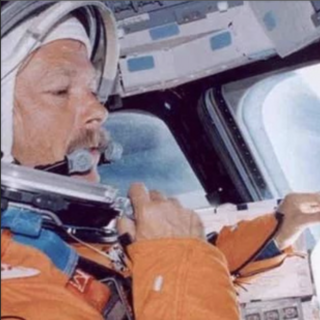
Robert L. “Hoot” Gibson commanded four of the five Space Shuttle missions on which he flew, including the first docking of a shuttle with the Russian space station Mir.

Gibson was born October 30, 1946, in Cooperstown, N.Y., and received a Bachelor of Science degree in aeronautical engineering from California Polytechnic State University in 1969. Following graduation, he entered the Navy and completed advanced flight training two years later. While assigned to Fighter Squadrons 111 and 1 between 1972 and 1975, he served aboard the aircraft carriers Coral Sea and Enterprise – flying combat missions in Southeast Asia. He later graduated from the Naval Fighter Weapons School, known as “Topgun,” and from the Navy Test Pilot School, Patuxent River, Md. In 1977 he was involved in testing the F14A aircraft while assigned to the Naval Air Test Center’s Strike Aircraft Test Directorate.

NASA selected Gibson for astronaut training in 1978. On his first flight, aboard Challenger in 1984, he was pilot on a mission in which the five-person crew properly deployed two communications satellites, but both failed to reach desired synchronous orbits because of upper stage rocket failures. The flight was the first in which astronauts tested the Manned Maneuvering Unit – with both Bruce McCandless and Robert Stewart flying untethered up to several hundred feet from the orbiter. Gibson was in command of a seven-man crew when Columbia was launched in January 1986, deploying a communications satellite and conducting experiments in astrophysics and materials processing, Later that month, the shuttle Challenger exploded after liftoff, killing its seven-person crew. Gibson participated in the investigation of the accident and contributed to the redesign of the solid fuel rocket boosters which caused the disaster.

Gibson flew the second mission after the Challenger explosion, commanding a five-person Atlantis crew on a 1988 classified military mission, during which a radar satellite was released and the astronauts performed experiments aimed at defining a human’s role as a military observer in space. Next up for Gibson was command of Endeavour, launched in 1992 with a seven-person crew, including the first Japanese astronaut. During eight days aloft, the astronauts focused on science and materials processing experiments in more than 40 investigations aboard a Spacelab module cradled in the shuttle cargo bay.

On his fifth and final space flight, Gibson in 1995 commanded Atlantis on the first shuttle mission to dock with Russia’s Mir space station. Atlantis was modified to carry a docking system compatible with the Mir’s. There was an exchange of crew members, and while the shuttle was launched with seven astronauts, it returned to earth after 10 days with eight. It was the 100th space mission for U.S. astronauts. To commemorate the event, Gibson carried with him the first American flag flown in space – by Alan Shepard on the first U.S. astronaut flight in 1961. The flag is now displayed in the Astronaut Hall of Fame.

Gibson retired from NASA in 1995. He is married to another shuttle astronaut, Dr. Rhea Seddon. Robert Gibson was inducted into the U.S. Astronaut Hall of Fame on June 21, 2003.

George Mason Materials Science Collaboration Reports First Thermopower Detection of Fractional quantum Hall Effect in Bilayer Graphene

By Tracy Mason

Novel thermopower measurement capabilities open new avenues for probing the topological properties of exotic quasiparticles, with potential implications in future quantum computers.

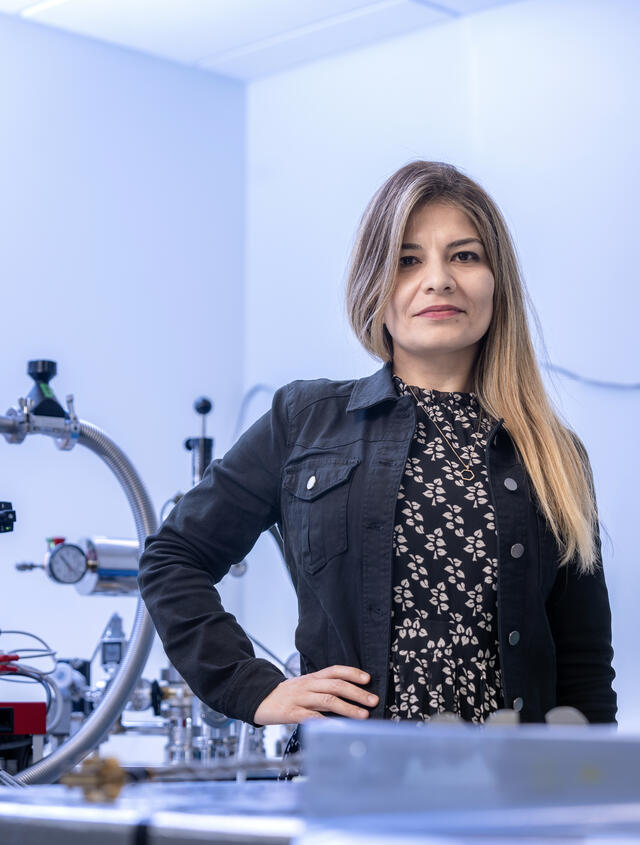
George Mason University physics and astronomy assistant professor Fereshte Ghahari and her team at George Mason University, along with collaborators including colleagues from Brown University and National Institute of Standards and Technology (NIST), report the first thermopower detection of Fractional quantum Hall (FQH) effect in bilayer graphene, a material consisting of two atom-thin layers of graphene. Their findings, published in Nature Physics, demonstrate that thermopower is a more sensitive probe of FQH effect compared to resistivity.

FQH effect is a quantum phenomenon that emerges in certain ultra-thin materials under high magnetic fields and extremely low temperatures. It is a particular state of matter where electrons interact strongly and in unexpected ways, giving rise to new particles that can potentially serve as the building blocks for future quantum computers. 

“For many years, electrical resistance measurements have been the primary tool to probe FQH effect in graphene systems, leaving alternate approaches underexplored,” said Ghahari. 

In essence, thermopower is the heating of one side of the material while keeping the other side cool. This causes the charged particles inside to shift toward the cooler side, creating a small electrical voltage. By looking at how the charges flow and the heat they carry in response to the temperature gradient, one can measure entropy, the degree of randomness. This entropic connection makes thermopower a powerful alternative tool to probe the topological properties of new particles and assess if they can be used in future quantum computers.

George Mason physics PhD student Nishat Sultana played an important role in this research by making specialized thermopower devices consisting of an isolated heater and local thermometers for producing and measuring the temperature gradient, respectively. She created a tiny sample made of bilayer graphene and then made the thermopower device using the nanofabrication facility at NIST’s Center for Nanoscale Science and Technology. She then measured it using a low temperature cryostat located at Ghahari’s lab at George Mason.

“We performed thermopower and resistivity measurements for a variety of devices at various temperatures and magnetic fields,” said Sultana. 

What the team observed was that FQH effect appears more strongly in thermopower compared to electrical resistance measurements at lower magnetic fields and higher temperatures, where resistivity measurements were inconclusive. Strikingly, new FQH states emerged in the thermal signal which had not been previously reported using resistivity measurements. Moreover, these studies raise the possibility that one of the newly observed FQH states may host topological entropy, making it a potential candidate for future topological quantum computing applications.

“This paper reports on the implementation of a unique tool for unlocking correlated phases in quantum materials,” shared Joel Schnur, a biomolecular science professor who has supported Ghahari’s efforts since she joined George Mason. “For example, this advance could play an important part in the development of quantum devices and lead to implementation of topological quantum computing,” Schnur explained.

These new measurements promise to provide additional insights about the FQH effect which cannot be accessed by other techniques. Overall, the findings by Ghahari and collaborators highlights the novel potential of thermopower measurements, opening new avenues for experimental and theoretical investigations of correlated and topological states in graphene systems, including moiré materials.

This Mason Science discovery was also highlighted in phys.org.